What Is Keratoconus?
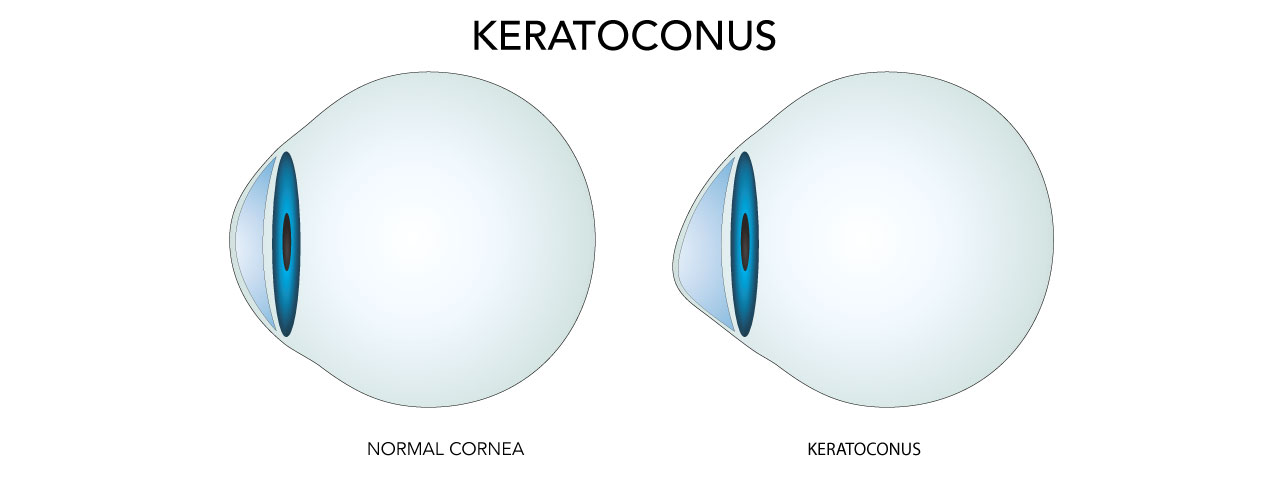
Keratoconus (keh-rah-toe-cone-us) is a condition in which the structure of the cornea is not strong enough to maintain its spherical shape, causing the cornea to bulge outward into a shape resembling a cone. This leads to a host of symptoms, including blurred and double vision, as well as halos around objects and streaks of light.
Below you’ll learn more about this condition and discover how Dr. Michael Antoine, O.D. at Antoine Eye Care Scleral Lens Center can offer a wide range of successful options, so you can keep enjoying clear and comfortable vision.
What is Keratoconus?
Keratoconus is a progressive eye disease in which the dome-shaped cornea thins, causing the cornea to develop a cone-like shape. The misshapen cornea deflects light, causing distorted vision and may result in blurred vision, double vision, myopia, irregular astigmatism and sensitivity to light.
This rare eye condition affects 1 out of every 2,000 people and typically begins in the teenage years and early 20s, with vision deteriorating over a period of about 10 to 20 years. It’s common for people with this disease to see prescription changes with each eye exam.
Keratoconus often runs in families, so if you or your children are at risk or are experiencing any of the symptoms mentioned below, contact Antoine Eye Care Scleral Lens Center for an eye exam. Keratoconus can only be diagnosed through a thorough eye exam, where Dr. Michael Antoine, O.D. will examine your cornea and measure its curvature.

What Causes Keratoconus
Your cornea is held in place by very small collagen fibers. When they are weakened, they cannot preserve the spherical dome-like shape of your cornea. The exact cause of keratoconus, however, is still unknown.
Weakening of the cornea tends to happen in those with a genetic predisposition, which is why keratoconus may affect several people in a single family.
Keratoconus has also been linked to:
- Excessive exposure to UV rays
- Excessive eye rubbing
- Difficulty wearing contact lenses
- Certain eye injuries
- Retinitis pigmentosa
- Marfan syndrome
- Ehlers-Danlos syndrome
Symptoms of Keratoconus
As the shape of your cornea begins to bulge, it alters your eyesight. Your normally smooth corneal surface becomes wavy and expands, becoming cone-shaped. This causes irregular astigmatism or nearsightedness. The condition tends to begin in one eye and later develops in the other eye as well.
Typically, one’s prescription will change frequently as vision worsens, over time it will also become more difficult to wear contact lenses due to the changing shape of the cornea. If the contact lenses are not properly fitted on someone with Keratoconus, the lenses may rub against the most vulnerable part of the cornea. The excessive rubbing then causes symptoms to worsen by aggravating the already thin cornea. When the symptoms of keratoconus intensify, the cornea can begin to swell and form scar tissue. This scar tissue can result in worsening visual distortion and blurred vision.

Symptoms during the early stages of keratoconus:
- Mild blurred vision
- Slightly distorted vision (straight lines appear bent or wavy)
- Some sensitivity to light and glare
- Red-eye and/or swelling
- Chronically irritated eyes
In its later stages, one tends to experience:
- Increased blurred and distorted vision
- Nearsightedness or irregular astigmatism
- Inability to wear regular contact lenses
Keratoconus Treatments
There are several ways to treat this condition. When the symptoms are still mild, you can correct your vision using eyeglasses. As the condition progresses, there are several treatment options.
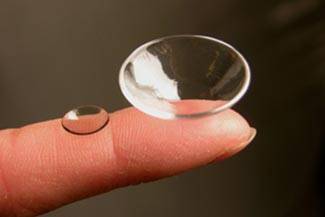
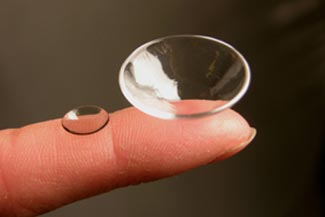
- Scleral contact lenses. For improved visual acuity, gas permeable scleral lenses are usually the preferred treatment. Scleral lenses vault over the cornea, replacing its irregular shape with a smooth, uniform refracting surface that provides clarity and comfort.
- Custom soft contact lenses. These customized soft lenses are specially designed to correct mild-to-moderate keratoconus.
- Piggyback contact lenses. For those with keratoconus, fitting a gas permeable (hard) contact lens over a cone-shaped cornea may at times prove uncomfortable. “Piggybacking” involves placing a soft contact lens over the eye and then placing a GP lens over the soft lens. This increases wearer comfort because the soft lens acts like a cushioning pad under the rigid GP lens.
- Hybrid contact lenses. These lenses combine a highly oxygen-permeable rigid center with a soft peripheral “skirt”. Some hybrid lenses are specifically designed for keratoconus, with the central GP area of the lens vaulting over the cone-shaped cornea.
- Intacs. This small curved device is surgically placed in your cornea to help flatten the corneal curvature and improve vision.
- Corneal collagen cross-linking. Used together, special UV light and eye drops can strengthen the cornea, thus flattening your cornea and preventing further expansion.
- Corneal transplant. As a last resort, you may be advised to undergo a corneal transplant, where all or part of your distorted cornea is replaced with healthy donor cornea tissue. Even after a transplant, however, you may still need to wear glasses or contact lenses for clear vision.
Contact Dr. Michael Antoine, O.D. at Antoine Eye Care Scleral Lens Center to find out whether scleral lenses are right for you.